Built on airline heritage. Driven by experience.

Aviation Career Center was not created in isolation.
It was built on decades of real airline experience — shaped within the operational environment of Slovenia’s national carrier, Adria Airways.

For many years, Adria Airways represented the foundation of Slovenian aviation, operating as the national airline with a strong presence across Europe and a long-standing tradition of training, operational excellence, and international cooperation.

It is within this environment that the core team behind Aviation Career Center developed their expertise.

From national airline to training excellence

The origins of Aviation Career Center are directly connected to the legacy of Adria Airways and its training organization.

Following the structural changes and eventual collapse of Adria Airways and its flight school, a group of experienced aviation professionals — including airline pilots, instructors, and training managers — came together with a clear objective: to preserve and further develop the knowledge, standards, and methodology built within the national airline system.

This transition was not a beginning from zero.
It was a continuation — carrying forward a proven approach to pilot training, refined through years of real airline operations.

Experience shaped by real operations

The foundation of Aviation Career Center lies in practical experience.

Our team includes former and active airline pilots, training managers, and aviation experts who built their careers within a professional airline environment. This background ensures that training is not theoretical, but directly aligned with the realities of commercial aviation.

The knowledge transferred to students is shaped by:

  • Real operational decision-making
  • Airline procedures and standards
  • Experience gained in complex, international environments

This connection to airline operations defines the character of Aviation Career Center.

Experience shaped by real operations

The foundation of Aviation Career Center lies in practical experience.

Our team includes former and active airline pilots, training managers, and aviation experts who built their careers within a professional airline environment. This background ensures that training is not theoretical, but directly aligned with the realities of commercial aviation.

The knowledge transferred to students is shaped by:

  • Real operational decision-making
  • Airline procedures and standards

A response to change — and an opportunity

The establishment of Aviation Career Center was also a response to a changing aviation landscape in Slovenia.

With the absence of a national carrier after Adria Airways ceased operations in 2019, a gap emerged — not only in the market, but in the continuity of aviation knowledge and training excellence.

Aviation Career Center was created to fill that gap.

By transferring expertise, maintaining high standards, and building a modern training environment, ACC continues the tradition of professional aviation training — adapted to today’s global industry.

Continuing a legacy

Today, Aviation Career Center represents more than a flight school.

It is a continuation of a legacy built within a national airline — a legacy of discipline, professionalism, and operational excellence. At the same time, it is a forward-looking organization, aligned with modern aviation standards and global expectations.

The experience gained through Adria Airways lives on in:

  • The structure of training programs
  • The mindset instilled in students
  • The standards applied in daily operations

From heritage to future

Every organization has a starting point.
Ours is rooted in airline experience.

But our direction is forward.

At Aviation Career Center, we combine the strength of our heritage with a clear vision for the future — developing pilots who are not only trained to meet today’s standards, but prepared to evolve with the industry.

Our Vision

Restoring and elevating the standard of pilot training

Aviation is evolving rapidly. Technology advances, operational environments become more complex, and the expectations placed on pilots continue to rise. Yet, in parallel, the global standard of pilot training has begun to drift — often diluted by scale, accelerated growth, and a focus on quantity over quality. At Aviation Career Center, we have taken a deliberate step in the opposite direction. Our vision is not simply to participate in pilot training — but to restore and elevate the standard by which it is defined.

A different approach, by design

Where others have expanded, we have remained selective.

Where numbers have grown, we have maintained focus.

We believe that professional pilot training cannot be industrialized without consequence. It requires precision, attention to detail, and an environment where every individual is developed with intention.

For this reason, we deliberately limit student intake. Smaller groups allow for closer guidance, clearer communication, and a level of training depth that cannot be achieved at scale.

This is not a constraint.
It is a choice — one that defines our standard.

Beyond minimum requirements

Regulatory standards are essential — but they are only the starting point.

Our vision is to go beyond minimum requirements and deliver training that reflects the true demands of modern aviation. This means combining robust theoretical knowledge with practical application, exposing students to real operational environments, and developing competence through structured, disciplined progression.

We do not train students to pass examinations.

We train them to perform.

Airline-oriented from the beginning

The aviation industry does not train pilots twice.

From the first day, students at Aviation Career Center are immersed in an environment that reflects professional aviation. Training is conducted using modern aircraft, advanced simulation, and procedures aligned with airline operations.

Communication, discipline, and decision-making are developed within a framework that mirrors real-world expectations — ensuring that the transition from training to airline operations is not a leap, but a continuation.

Training is not preparation for aviation.

It is aviation — from the very beginning.

Defined by outcomes

Success is not measured by how many students enroll.

It is defined by what they become.

At Aviation Career Center, our benchmark is the long-term success of our graduates — their ability to integrate into professional environments, perform under pressure, and build sustainable careers in aviation.

Every decision we make, every process we design, and every standard we uphold is aligned with this objective.

Knowledge, delivered with precision

High-quality training begins with high-quality knowledge transfer.

Our programs are designed to go beyond standard requirements, ensuring depth of understanding and operational awareness. Ground training and flight training are integrated, structured, and continuously reinforced.

Instruction is delivered by experienced aviation professionals — individuals who bring real airline knowledge into every stage of training, ensuring that learning is not theoretical, but directly applicable.

Creating a real aviation environment

The training environment defines the outcome.

At Aviation Career Center, students train in conditions that reflect real aviation — operating from an international airport, flying in controlled airspace, and working within procedures used in commercial operations.

Glass-cockpit aircraft, structured workflows, and airline-oriented training practices ensure that students develop familiarity with the systems, expectations, and discipline required in professional cockpits.

This is not simulation of reality.

It is exposure to it.

A future-focused vision

Aviation will continue to evolve — and so will the demands placed on pilots.

Our vision is not static. It is a continuous process of refinement, adaptation, and improvement. By staying aligned with industry developments and operational realities, we ensure that our training remains relevant in a changing global environment.

We prepare pilots not only for their first role — but for the progression that follows.

Building professionals

At its core, our vision extends beyond training.

We aim to develop individuals who understand responsibility, act with discipline, and operate with confidence and precision. These are the qualities that define professional pilots — and they are embedded into every stage of training.

Because aviation does not need more licenses.

It needs professionals.

The standard we set

Our vision is simple, but uncompromising:

To restore and elevate the standard of pilot training — and to maintain it through precision, discipline, and consistency.

Our Team

Experience that defines the standard

Behind every successful pilot stands a team that shaped their journey.

At Aviation Career Center, our strength lies in the people who deliver the training — professionals whose experience is rooted not only in instruction, but in real airline operations. The team is composed of highly experienced aviation specialists, including airline pilots, training managers, regulatory experts, and instructors who have spent years operating within complex, international aviation environments.

This foundation ensures that training is never theoretical. It is practical, relevant, and aligned with the realities of modern aviation.

Built on airline expertise

The team at Aviation Career Center has been shaped by years of experience within professional airline environments.

From A320 airline pilots and certified training developers to former aviation authority executives and airline training managers, each member brings a depth of knowledge that directly reflects industry standards.

This collective expertise defines the way training is delivered — structured, disciplined, and focused on real-world application. Students are not only taught how to fly, but how to think, decide, and operate as airline professionals.

Instructors who lead by example

Instruction at Aviation Career Center is based on mentorship as much as it is on training.

Our instructors are not only educators, but active aviation professionals who bring operational insight into every lesson. Their role extends beyond delivering knowledge — they guide, challenge, and support students throughout their development.

By working closely with small groups, instructors are able to provide individual attention, ensuring that each student progresses with clarity and confidence.

A focused and personal approach

At Aviation Career Center, training is intentionally personal.

We maintain small group sizes, typically limited to a select number of students, allowing for direct interaction between students and instructors. This creates an environment where communication is clear, feedback is immediate, and development is continuous.

The result is a training experience where every individual is known, supported, and held to a high standard.

A team aligned with a common purpose

While backgrounds and roles may differ, every member of Aviation Career Center shares a common objective: to develop pilots who are prepared for professional aviation.

This alignment ensures consistency across all areas of training — from classroom instruction to flight operations, from simulation to real-world application. It also creates a culture where standards are not only maintained, but continuously reinforced.

More than instructors

The Aviation Career Center team extends beyond flight instructors.

Operational staff, training coordinators, and support personnel all play a critical role in ensuring that the training environment remains structured, efficient, and reliable. Together, they create the conditions required for students to focus fully on their development.

This integrated approach reflects the nature of aviation itself — where success depends on coordination, communication, and shared responsibility.

Shaping the next generation

Every student who joins Aviation Career Center brings ambition.

Our team’s role is to shape that ambition into capability — through guidance, discipline, and experience. By combining airline expertise with a structured training environment, we ensure that each graduate is prepared not only to meet industry standards, but to operate confidently within them.

Defined by people

Facilities, aircraft, and technology all play an important role in training.

But ultimately, it is the people who define the outcome.

At Aviation Career Center, our team represents the standard we expect — professional, experienced, and committed to excellence in aviation.

Our Fleet

Built for training. Aligned with real-world aviation.

In aviation training, the aircraft is more than a machine — it is the environment in which discipline, precision, and decision-making are developed.

At Aviation Career Center, our fleet is carefully selected to support every phase of pilot training. Each aircraft plays a defined role within a structured progression, ensuring that students develop the skills, awareness, and confidence required for modern aviation.

Training through progression

A pilot’s journey is built step by step.

From initial flight experience to advanced multi-engine operations, our fleet supports a continuous and structured development path. Each aircraft introduces new levels of complexity, responsibility, and operational awareness — preparing students for the realities of professional aviation.

A focused and personal approach

At Aviation Career Center, training is intentionally personal.

We maintain small group sizes, typically limited to a select number of students, allowing for direct interaction between students and instructors. This creates an environment where communication is clear, feedback is immediate, and development is continuous.

The result is a training experience where every individual is known, supported, and held to a high standard.

Single-Engine Training Fleet

Precision. Stability Foundation.

Our single-engine aircraft form the foundation of training, where students develop core flying skills, situational awareness, and operational discipline.

The fleet includes:

  • Evektor SportStar RTC
  • PS-28 Cruiser
  • Diamond DA40
  • Cessna 172

Each aircraft offers a modern training environment, with reliable performance and avionics aligned with current aviation standards. This allows students to build strong fundamentals while becoming familiar with cockpit layouts and procedures used in contemporary aviation.

Training focus is placed on aircraft handling, navigation, communication, and precision flying — establishing the foundation required for all future phases.

INTERNATIONAL AIRPORT MARIBOR

Multi-Engine Training Fleet

Complexity. Performance. Decision-making.

As training progresses, students transition into multi-engine aircraft, where complexity and responsibility increase significantly.

Our multi-engine fleet includes:

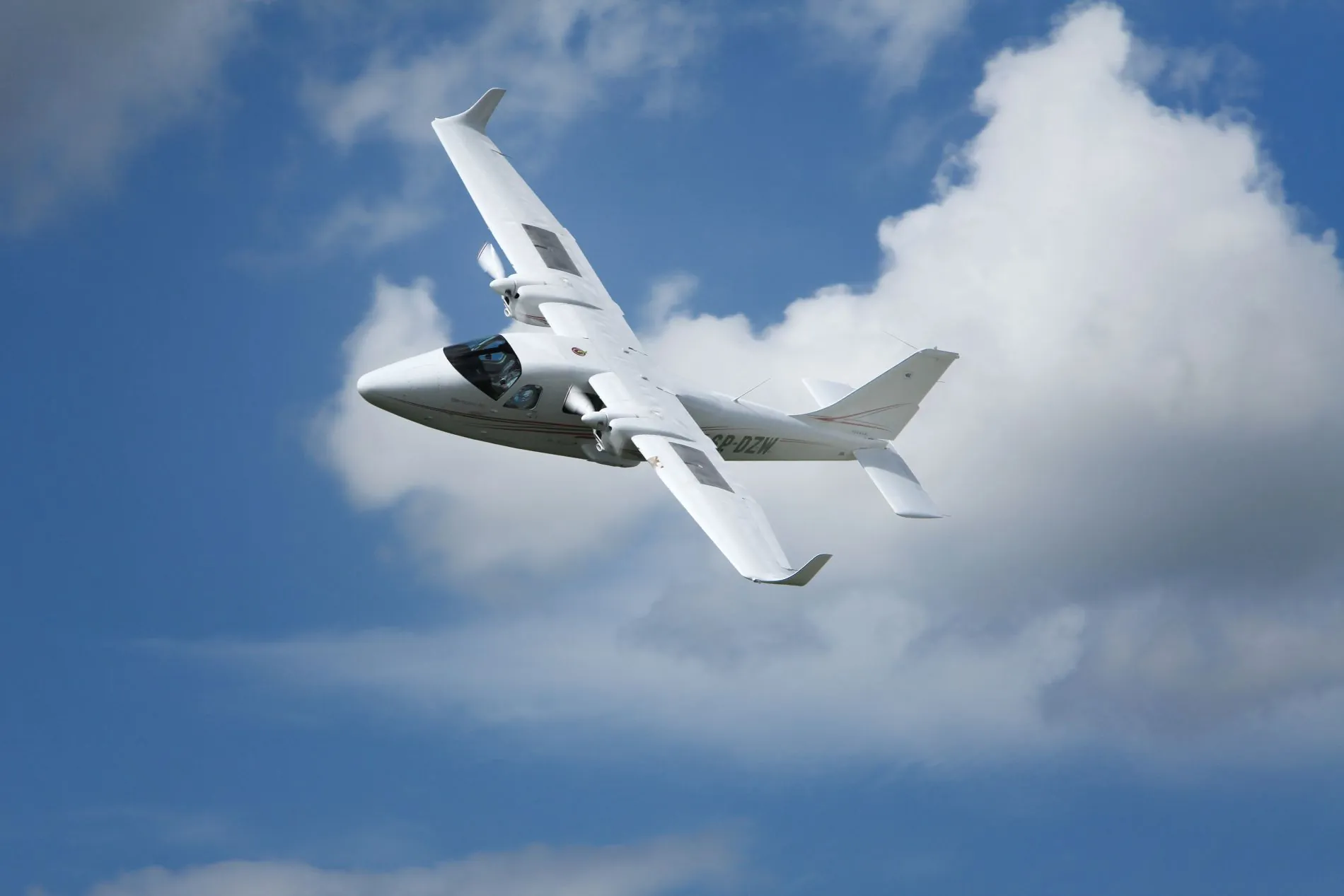
  • Tecnam P2006T
  • Diamond DA42

These aircraft introduce advanced systems, redundancy management, and asymmetric flight operations. Students develop a deeper understanding of aircraft systems, performance management, and decision-making under more demanding conditions.

This phase represents a critical step toward commercial aviation readiness.

Advanced Simulation

Bridging training and airline operations

Flight training is complemented by advanced simulation using the:

  • ALSIM AL250 FNPT II Simulator

This simulator provides a highly realistic environment for instrument training, procedural development, and complex scenario-based exercises.

Students are able to:

  • Practice instrument procedures in controlled conditions
  • Train for abnormal and emergency situations
  • Develop multi-crew coordination skills
  • Build confidence before entering real aircraft environments

Simulation enhances efficiency, safety, and depth of learning — forming an essential part of the training process.

Simulation enhances efficiency, safety, and depth of learning — forming an essential part of the training process.

Maintained to the highest standards

Every aircraft in our fleet is maintained in accordance with strict EASA regulations and internal quality standards.

Airworthiness, reliability, and operational readiness are ensured at all times. Maintenance is performed with precision and consistency, reflecting the expectations of professional aviation — where safety is absolute.

Efficiency and responsibility

Our fleet is also aligned with a more responsible approach to aviation.

By operating aircraft using RON95 unleaded fuel, Aviation Career Center significantly reduces environmental impact compared to traditional aviation fuels. This eliminates lead emissions and supports a cleaner training environment — both in the air and on the ground.

Efficiency in aircraft operation, combined with modern training methods, ensures that performance and responsibility go hand in hand.

A fleet designed for your future

Every aircraft, every system, and every training phase is aligned with one objective: preparing you for professional aviation.

The transition from student to pilot requires more than flight hours — it requires the right environment, the right progression, and the right exposure.

Our fleet is designed to deliver exactly that.

Defined by purpose

At Aviation Career Center, our fleet is not defined by size.

It is defined by its role — to support disciplined training, ensure consistent progression, and reflect the standards of modern aviation.

Airport

A real-world aviation environment from day one

At Aviation Career Center, training begins where aviation truly happens — at a fully operational international airport.

Maribor Edvard Rusjan Airport (LJMB) is not a training airfield separated from reality. It is an active aviation environment where procedures, communication, and operational awareness are developed under real conditions. This exposure is fundamental in shaping pilots who are prepared not only to fly, but to operate professionally.

Precision, infrastructure, and operational relevance

Located just a few minutes from the city of Maribor, the airport serves as Slovenia’s second international airport and plays a key role in both commercial aviation and flight training.

With a 2,500-meter asphalt runway, the airport is capable of handling a wide range of aircraft, from training platforms to larger commercial operations.

The airport is equipped with Instrument Landing System (ILS CAT I), allowing operations in reduced visibility and supporting instrument training under realistic conditions.

Its infrastructure includes:

  • Full air traffic control environment
  • Ground handling and operational support
  • Customs and international entry capabilities
  • Modern terminal facilities

This combination creates a setting that closely reflects airline operations — an essential advantage for pilot development.

A training environment used by professionals

Maribor Airport has become a recognized location for aviation training across Europe.

Its controlled airspace, combined with moderate traffic levels, creates an ideal balance: complex enough to reflect real-world operations, yet efficient enough to allow continuous training progression.

Students train alongside other aircraft, communicate with active air traffic control, and adapt to real operational flows — gaining experience that cannot be replicated in isolated training environments.

Efficiency without compromise

One of the defining advantages of Maribor Airport is its operational efficiency.

With low congestion and minimal delays, students spend more time flying and less time waiting. Short taxi times and streamlined procedures contribute to a highly productive training environment, where every flight hour is maximized.

At the same time, the airport maintains the structure and discipline of controlled operations — ensuring that efficiency never comes at the expense of realism.

Infrastructure that supports progression

The airport features multiple runways, including a secondary grass runway, allowing flexibility in training scenarios and operational planning.

This flexibility supports a wide range of training exercises, from basic handling to advanced procedures, and allows adaptation to varying weather and operational conditions.

Combined with modern navigation aids, lighting systems, and communication infrastructure, the airport provides a complete and reliable training platform.

A legacy of aviation

Maribor Airport is not only a modern facility — it is also part of a long aviation tradition.

The presence of one of the oldest aeroclubs in the region, established in 1927, reflects a deep-rooted aviation culture that continues to influence training and operations today.

This heritage contributes to an environment where aviation is not simply practiced — it is understood.

Built for real aviation

Training at Aviation Career Center means learning in conditions that reflect the industry from the very beginning.

Students develop:

  • Confidence in controlled airspace
  • Precision in communication and procedures
  • Awareness of real traffic environments
  • Discipline in operational decision-making

These elements form the foundation of professional aviation — and they are developed not in simulation alone, but in real operational settings.

Where training becomes experience

At Aviation Career Center, the airport is not just a location.

It is where theory meets practice.
Where procedures become instinct.
Where training becomes experience.

Ratings & Reviews

Registered Office: Naselje Borisa Kidriča 4, SI-8330, Metlika, Slovenia, EU
Training Location: International Airport Maribor, Letališka cesta 10, 2312 Orehova vas, Slovenia, EU
linkedin facebook pinterest youtube rss twitter instagram facebook-blank rss-blank linkedin-blank pinterest youtube twitter instagram